Our publications
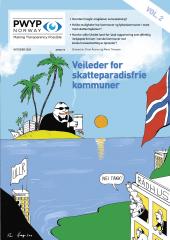
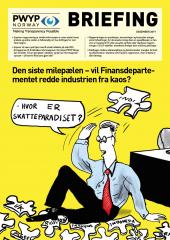
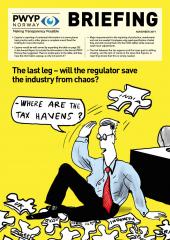
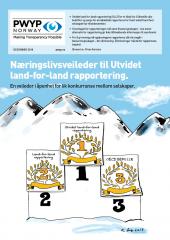
Below is a collection of PWYP Norway’s publications, sorted by publication month. We welcome you to download our publications and background material, of course without any cost, but please quote us explicitly if you use any of our material in your work (”Title/PWYP Norway/http://www.publishwhatyoupay.no/publications”).
The contributing illustrators and photographers have copyright to their material.
Finansiell Åpenhet: Grep for å styrke demokrati og rettferdig fordeling
Report by Norwegian MFA as part of the Dialogue project
Summary: Artikkelsamling utgitt av Utenriksdepartementet som et ledd i Dialoprosjektet kapital for utvikling. Samlingen inneholder forslag fra prosjektets samarbeidspartnere, og PWYP Norge har bidratt med artikkelen “Utvinningsindustrien og de sju sekretessemekanismene – Hvorfor vi trenger en land-for-land rapportering” (s.12-26).
Not available in English
Written by: Various contributors
Publication date: January 2012
An extended country-by-country reporting standard. A policy proposal to the EU.
Summary: 2/3 of the poorest people in the world live in resource rich countries. Natural resources has the largest value creation potential to mobilize own capital, but profit often ends up elsewhere. Today, the extractive industries can transfer significant profits out of the source country before it is taxed.
One simple policy proposal will give investors and other constituents the instrument to follow their money.
Written by: Richard Murphy, rewritten and adapted by Frian Aarsnes
Publication date: January 2012
ISBN: 978-82-93212-03-4
Lost Billions. Transfer Pricing in the Extractive Industries
Summary: Over 110 billion USD has disappeared through mispricing of crude oil in the US and the EU between 2000 and 2010. Profits have been moved from the source country to the extractive industry companies.
In December 2000, the Netherlands imported crude oil for the price of 1,69 Euro per bbl. while the spot market prices were no lower than 26 Euro, resulting in an underevaluation of around 40 million Euro to the source country.
Written by: Phd. Simon J. Pak
Publication date: January 2012
Download – English (ISBN 978-82-93212-04-1)
Download data in Excel and try cracking the numbers yourself:
1. Import_detail_EU_crude.xls: Detailed records of EU import of PETROLEUM OILS AND OILS OBTAINED FROM BITUMINOUS MINERALS, CRUDE (EXCL. NATURAL GAS CONDENSATES), 2000-2010 (NC8=27090090). EUROSTAT External Trade Data (http://epp.eurostat.ec.europa.eu/portal/page/portal/external_trade/data/...)
2. Import_detail_EU_n.gas.xls: Detailed records of EU import of NATURAL GAS CONDENSATES, 2000-2010 (NC8=27090010). EUROSTAT External Trade Data (http://epp.eurostat.ec.europa.eu/portal/page/portal/external_trade/data/...)
3. Import_detail_US_crude.xls: Detailed records of US Import of Crude Petroleum, 2000 – 2010: two HS10 codes for API >25 (HS10: 2709002000 & 2709002090) and HS10 code for API<25 (HS10: 2709001000) from the U.S. Imports of Merchandise. U.S. Census Bureau, U.S. Foreign Trade Data Downloads (http://www.census.gov/foreign-trade/download/dvd/index.html)
4. crude_detl_cif_factor_data.xls: Insurance-freight cost of crude oil (USD per bbl, monthly average) from the U.S. Imports of Merchandise, U.S. Census Bureau, U.S. Foreign Trade Data Downloads (http://www.census.gov/foreign-trade/download/dvd/index.html)
5. PET_PRI_IMC3_K_M_fob-by-api.xls: F.O.B. Costs of Imported Crude Oil by API Gravity, U.S. Energy Information Administration
6. FX_USD_EUR.xls: Euro-USD exchange rates – monthly data from Euro/ECU exchange rates – Monthly data, EUROSTAT (http://epp.eurostat.ec.europa.eu/portal/page/portal/exchange_rates/data/...)
(ref “Appendix II” in report)
Protection from derivative abuse
Summary: Extractive industries are big users of a financial instrument called derivatives, which can be abused to transfer revenues out of host countries before it is taxed.
The value behind all derivatives is 10 times the world GDP.
One simple policy proposal can be enacted upon unilaterally to stop abuse, while protecting proper use of these instruments.
Written by: Frian Aarsnes
Publication date: December 2011
Download – English (ISBN 978-82-93212-01-0)
Download – Norsk (ISBN 978-82-93212-02-7)
Piping Profits
Summary: In this report, PWYP Norway has attempted to unravel the labyrinthine corporate structures created by some of the world’s biggest energy and mining companies.
Few details are known about the murky and expansive networks of extractive companies and their subsidiaries. PWYP Norway seeks to clarify this picture by finding out how many subsidiaries companies have and where these are located, also establishing through this process how many are located in secrecy jurisdictions.
Read more and browse data in the Piping Profits database
Written by: Nick Mathiason
Publication date: September 2011 (Updated English version: November 2011)
Download – English (ISBN 978-82-93212-00-3)
Download – Español
TRACE Briefings 2010-2011
Summary: A step in completing the TRACE programme, the 2010-2011-participants have worked together to produce short briefings on four selected topics: “contract transparency”, “environmental issues related to EI”, “indigenous peoples´ rights and EI”, and “illicit financial flows and secrecy jurisdictions”.
The hope is that these briefings will be useful for those who did not have the chance to join in the programme, but would like insight into the topics.
Written by: TRACE-participants and external consultants
Publication date: October 2011
Download all briefings – English
Download all briefings – Español
Download briefings separately
Defining Elements (draft paper for discussion)
Summary: Defining Elements outlines which concrete elements should be made subject for regulation in a full country-by-country reporting standard for the extractive industry. It is based on input from CSOs, tax experts, accounting experts, private sector, and PWYP Norway´s experiences with other processes. This is a draft for discussion, and input in writing is appreciated (input gathering is now closed).
Written by: Richard Murphy
Publication date: May 2011
How should country-by-country reporting for companies in the extractive industries be introduced in Norway?
Summary: This brief legal report, commissioned by PWYP Norway and written by the Norwegian law firm, Arntzen de Besche, suggests how Norway can implement a country-by-country reporting regulation in Norwegian law, that easily can open up for further and necessary regulation.
The report summarizes the ongoing processes in the US and EU, and provides a legal consideration of a suggestion for how a Norwegian law text for the extractives sector can be based upon this.
Written by: Arntzen de Besche Advokatfirma AS
Publication date: April 2011
Striking Oil: Blessing or Curse?
Summary: The first round of PWYP Norway’s capacity strengthening programme was concluded in December 2009. UK based INTRAC and PWYP Norway have developed a paper in the Praxis Note-series, seeking to capture the lessons learnt from the first round of the programme; a practical experience of capacity development with CSOs in seven African countries to promote greater transparency over oil revenues.
Written by: Helen Collinson and Rod MacLeod
Publication date: June 2010
Download – English
Download – French
Download – Spanish
Download – Portuguese
Download – Arabic
Download – Russian